


Prologue
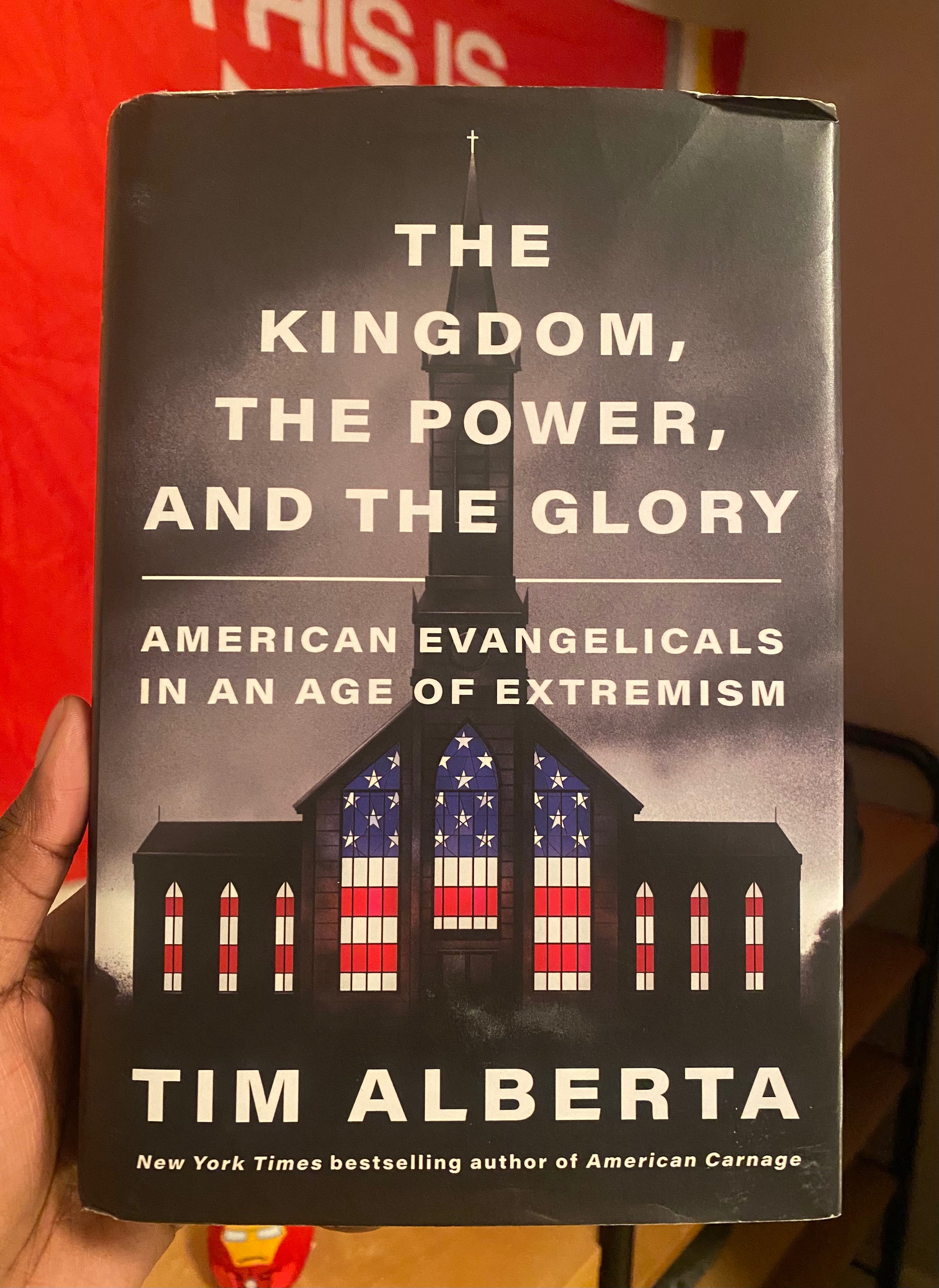
In last week’s post, I highlighted Tim Alberta’s Pauline critique of Christians whose political projects tend to obscure their responsibility to build the Kingdom of God on the earth. “Paul recognizes that evil exists in our world,” I wrote, “and duly advocates for fighting back against it as Christians.”
However, he stresses that the weapons of our warfare are not conventional. While the conservative’s war often ends up being waged against the liberal (and vice versa), the Christian’s war ought to be waged primarily against the powers of darkness behind the evil in our world.
Our prayer lives are then partially reframed as the arena in which any activism we might engage in is conceived and fostered. “Your kingdom come, your will be done, on earth as it is in heaven,” the faithful Christian prays to God daily (Matthew 6:10 ESV) before asking Him to “deliver us from evil” (v.13b).
The danger of failing to ground our politics in prayer is that this will invariably cause us to lose sight of the spiritual realities which govern our world. We will begin to serve earthly causes and masters with more fervour than we serve God Himself. And, as I explore in the following, we will begin to view our fellow man — and, God forbid, our fellow Christian — as the enemy whenever they disagree with us.
What Is an American Evangelical?
Alberta’s beef in The Kingdom, the Power, and the Glory, as the book’s subtitle suggests, is specifically with the group he identifies as “American evangelicals.” The trouble with this designation is that it has come to mean different things to different people over the years. Take for example the debate below, moderated by The Gospel Coalition in 2022, wherein Ryan Burge — prolific author of the Graphs about Religion Substack — argues that the word “evangelical” has been “pulled away from its historical roots and is now a term that denotes a social and political orientation more than it expresses a connection to the Gospel of Jesus Christ” (see 15-minute mark).
Alberta agrees with Burge’s verdict. He explains that the English word “evangelical” was first used centuries ago “to distinguish reformed Protestants, with their revivalist aims, from the staid customs of Catholicism.” And by the end of the World War II, an evangelical was, in the words of historian George Marsden, “anyone who likes Billy Graham”—even though Graham himself was famously quoted as saying that the definition of the word was a question he “would like to ask somebody, too” (10).
With the rise of the Moral Majority in the 1980s, however, the word “soon became synonymous with ‘conservative Christian,’ and eventually with ‘white conservative Republican’” (11). Notably, this trend managed to confine itself within the borders of the United States. As the Australian-born professor of Biblical Studies at Wheaton College John Dickson explains, “the original evangelicalism has remained in both Britain and Australia, while America sort of went its own way” (138).
We Must Draw Appropriate Lines
One of the foremost contributors to American evangelicalism’s political radicalization in the latter half of the twentieth century was the widely read columnist Cal Thomas, whose résumé also included five years as spokesman for Jerry Falwell Sr.—co-founder of the Moral Majority. Thomas was “an evangelical Christian and a political conservative—and, once upon a time, he had used those labels interchangeably” (201). Why was it, then, that he no longer felt comfortable doing so?
In short, it was because of his reflections on his time on the frontlines of the Moral Majority’s fight to Christianize America through conservative victories at the ballot box. In his 1999 book Blinded by Might: Can the Religious Right Save America? — which he authored alongside his friend and onetime colleague at the Moral Majority, Pastor Ed Dobson — Thomas confessed that their political activism “had not ushered in the sort of kingdom-on-earth spiritual utopia about which they and so many American evangelicals fantasized” (201).
Instead, they watched as American culture moved further and further to the left in spite of strong Republican showings in the occasional election. “Winning campaigns had become more important than winning converts,” they noticed, “scolding the culture… more important than sanctifying the Church” (202). Their takeaway from this upsetting outcome:
We think it is time to admit that because we are using the wrong weapons, we are losing the battle.
Thus, they proceeded to advocate for what Alberta calls “a wholesale reestablishing of boundaries and priorities” (201). A generation later, Thomas still strongly identifies as both an evangelical Christian and a conservative Republican, having voted for Donald Trump in each of the last three presidential elections. When Alberta interviewed him in the fall of 2022, he explained that “the difference between the old Thomas and the new Thomas… is that those identities were now rigidly and properly ordered” (203). As Alberta observed:
This gave him an intellectual autonomy to which his brethren could not relate. Thomas had no issue lauding Trump one day and lashing him the next; taking Republicans to task for falling short of certain moral standards and praising Democrats for meeting others. His organizing principle was not a party platform, but the Sermon on the Mount. Instead of considering his faith in the context of politics, Thomas considered his politics in the context of his faith.
While this independent approach continues to draw many to his columns, it has also earned him a most venomous kind of critic. “I got a letter the other day when I wrote something critical of Trump,” he recalls for example, “The guy accused me of not even being a Christian” (203). In today’s extremist climate, there are indeed Christians for whom the fault lines which determine whether someone is a brother or sister in Christ are not even theological, but rather political. This is incredible. Not only is it incredible; it is unacceptable.
“For I handed on to you as of first importance what I in turn had received,” wrote the Apostle Paul to the church at Corinth in what has since been referred to as Christianity’s first ever creed (1 Corinthians 15:3-7):
That Christ died for our sins in accordance with the scriptures and that he was buried and that he was raised on the third day in accordance with the scriptures and that he appeared to Cephas, then to the twelve. Then he appeared to more than five hundred brothers and sisters at one time, most of whom are still alive, though some have died. Then he appeared to James, then to all the apostles.
This Gospel is what ought to bind all Christians together. It transcends all dividing lines which may pit humans against each other; things like race, gender, socioeconomic status, nationality and, yes, even political affiliation.
Ruthie’s Take
I have had many a conversation on this subject with my friend and former TWU Discipleship colleague Ruthanne Downey. Born in Croatia and raised in California, Ruthie is an International Studies major at Trinity Western University and is currently working as an intern in the House of Commons over in Ottawa. I asked her to contribute a paragraph or two to this post over the weekend and, as per usual, she overdelivered. Below are her thoughts on what healthy political engagement looks like for followers of Jesus.
The clearcut civic responsibility of any Christian is to be able to say of themself that their political stances are informed by an understanding of what we have been called to by Christ. This notion becomes complicated when sincere, Gospel-believing Christians have different understandings of what that is. Many of us have been on either side of this. Listening to a brother or sister in Christ and wondering what kind of Bible translation led them to a belief that seems in direct opposition to our own.
The way forward as Christians is clear:
Do not be easily offendable. The ministry of reconciliation and unity within the body of Christ that we are called to in 2 Corinthians is made even more difficult when a criticism of our tightly held beliefs is interpreted as a personal attack.
Be comfortable with disassociation from a certain tribe. The modern political climate has evolved to one that is incapable of capturing nuance. To be Liberal is to be Rachel Maddow, and to be Conservative is to be Charlie Kirk. The kind of polarization that we have become too comfortable with pigeonholes us into an identity that comes with a sense of “the other.” Whoever that may be.
Maintain the ability to both think critically and engage with others about any belief that you feel is worth defending.
Understand that even opposing views are often rooted in the same core value. No one likes kids being shot in schools, abortion is always heartbreaking, everyone wants to walk safe on their streets, justice should always prevail.
As Christians, we must never lose sight of the fact that someone’s political stances will not cause their disallowance from the Wedding Feast. The role of the Church is not to be a voting bloc—it is to declare the glory of Christ until He comes again. If nothing else, you are united to your Christian brother or sister by a longing to see that day come.
And in the words of Dr. Leanne J. Smythe, no matter what you believe, “Pray more than you scroll.”
Epilogue: Our Johannine Imperative
There is a passage in the seventeenth chapter of John’s Gospel that first caught my attention when I was fifteen years old. The chapter contains what is commonly referred to as Jesus’s “high priestly prayer.” In the prayer, Jesus intercedes for Himself and for His disciples before shifting His attention to all of us who would later come to believe the Gospel:
I ask not only on behalf of these but also on behalf of those who believe in me through their word, that they may all be one. As you, Father, are in me and I am in you, may they also be in us, so that the world may believe that you have sent me. The glory that you have given me I have given them, so that they may be one, as we are one, I in them and you in me, that they may become completely one, so that the world may know that you have sent me and have loved them even as you have loved me.
It is clear from these verses that arguably the most adverse effect of disunity in the body of Christ is that it constitutes a poor witness to those who are not yet Christians. “Fixation on this world,” as Alberta puts it, and on the things within it which have the potential to divide us can create a “barrier of entry for those seeking knowledge about the next” (119). Let this motivate us to be tolerant of our brothers and sisters in Christ whose political views we may vehemently disagree with.