


What is the sexual urge, other than a strange term?
According to H.T. Willetts’s English translation of Karol Wojtyla’s (better known as Pope John Paul II’s) Love and Responsibility, the sexual urge is a “specific orientation of the whole human being… towards a human being of the other sex” (see chapter 5). In addition to providing the “raw material” for love between two persons (chapter 3), the sexual urge finds its fulfillment in the continuation of the human race.
In the book’s first chapter, Wojtyla argues that “the sexual urge is by its nature dependent on the person.” In other words:
It is in control of the person, and the person can use it, can turn it to such purposes as he or she thinks fit. It must be added that this in no way lessens the force of the sexual urge.
It is precisely this force which I had in mind when I DM’d Haley Baumeister — author of “Life Considered” on Substack — with a burning question after church one Sunday afternoon.

“Why is it that there is hardly a spiritual counterpart to the sex drive?” I asked her. “While the sex drive orients us towards intimacy with created beings,” I continued, “wouldn’t life with God be so much easier if there was a similarly potent spiritual drive to orient us towards Him, the Creator?”
I was convinced that such a drive was what kept King David, a.k.a. the man after God’s own heart, in a “constant state of yearning for the presence & heart of God.” I wanted a piece of that. Attaining to that place, however, felt analogous to swimming upstream. And I was tired of it.
Haley described my question as “worthy” and “really interesting” but did not pretend to have a ready answer to it. And who could blame her? It was not exactly a normal question. In the couple of months since I asked it, though, I believe I have been blessed with a series of mini-epiphanies which have brought me to my current perspective on the issue.
My journey has in some ways mirrored that of Dr. Chuck Macknee—a former professor in my alma mater’s psychology department. Dr. Macknee’s signature course before he retired in 2023 was on human sexuality, as was the bulk of his published research. Since I was not a psychology major myself, the only time I actually heard him lecture was when he appeared on a panel along with an assortment of theologians and biblical scholars on campus to share their wisdom re. all things sex.
I remember him pointing out that sexuality and spirituality were inextricably linked because they shared a common source, i.e., humankind’s incomplete soul and its longing for wholeness.
According to this logic, man senses that his soul is missing something, so his sexuality orients him towards woman (or sometimes elsewhere, as we know). Similarly, he senses that his soul is missing something, so his innate spirituality orients him towards God—or to whatever false god he would rather worship. It makes a great deal of sense.
It made a great deal of sense to Macknee as well, especially when he would encounter clients in his counseling practice whose sexuality and spirituality interacted in remarkable ways. Towards the end of his doctoral thesis, submitted in September 1997, he wrote that “clients who were frustrated in their attempts to find God often, to their amazement, realized God’s closeness following or during a profound sexual connection.” On the other hand:
Clients who suffered from sexual distress or unfulfillment experienced significant relief and resolution when they had a meaningful spiritual experience.1
Macknee would go on to read the writings of prominent Christian mystics in the fourteenth, fifteenth and sixteenth centuries—saints like Catherine of Sienna, Teresa of Avila, John of the Cross and Julian of Norwich. The more he read, the more he grew “fascinated by their deeply passionate connection with God.” It appeared as though these mystics, like King David, were possessed with a spiritual drive which awakened them to their innate desire to pursue the Lover and Creator of their souls.
As the reader may discern from the above selection of quotes (shoutout Griffin Gooch), it is quite clear that the mystics’ intimacy with the Lord was rooted in a robust understanding of how He felt about them. They understood that the narrative of Scripture may be interpreted as one big Love Story featuring the triune God as the initiator/main character and humanity as the interest of His passionate love. Don’t believe me? Take it up with the Apostle Paul in Ephesians 5:
31“For this reason a man will leave his father and mother and be joined to his wife, and the two will become one flesh.” 32This is a great mystery, but I am speaking about Christ and the church.
According to N.T. Wright in chapter eight of his 2025 book The Vision of Ephesians:
Paul is interpreting Genesis 2 as a long-range prophecy of God’s son leaving his original home and going to find his appointed bride… Jesus the Messiah takes up the role of bridegroom—a role marked out in scripture for YHWH himself.
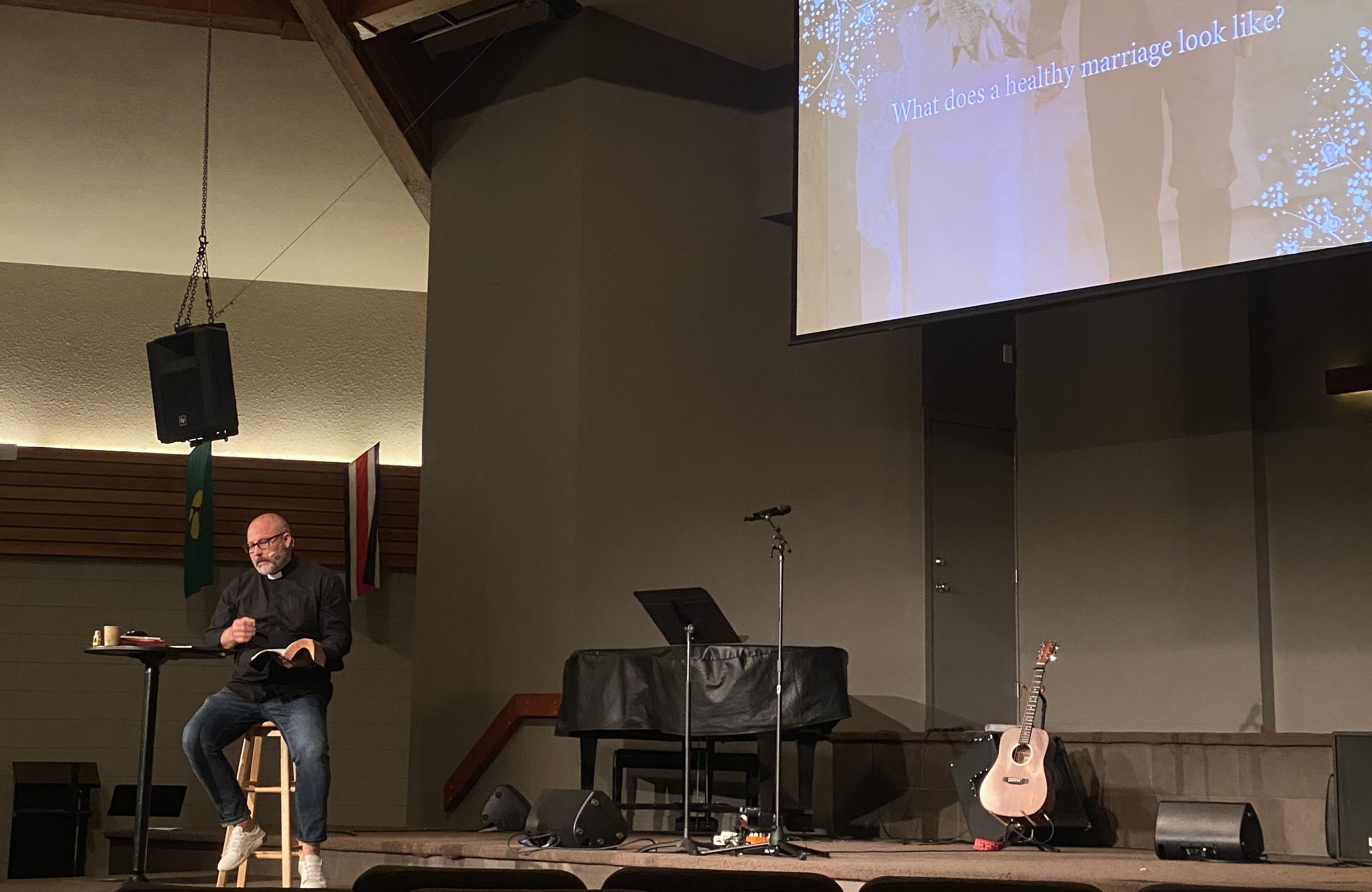
I had the pleasure of volunteering at a marriage conference co-hosted by my church last night and my pastor shared a quote from Ray Ortlund in Marriage and the Mystery of the Gospel that crystallizes Paul’s point as translated above by Wright:
We should not think that Christ and the Church are the metaphor in this passage, but the reverse. Christ and the Church are the reality of realities, and our Christian marriages are the metaphor.
The logical conclusions of this theology are profound. It means that for those of us who identify as Christians, God is not only Father (see Monday’s post) and Friend (stay tuned for part 3), but also Lover (in the romantic sense). The metaphors abound, to be sure, but each one is helpful in adding texture to our understanding of how God invites us to relate to Him. In fact, understood sacramentally, the entire cosmos can be a window into experiencing more of Him.
My friend Mandy Morris wrote earlier this week about the Corinthian Christians Paul addressed in the New Testament:
The Corinthians argued that sex was simply appetite, like hunger, like food. Paul refused that comparison. Sexual union creates real oneness, biologically, emotionally, neurologically.
While I agree that the human hunger for food is inherently different from the human hunger for sexual union, I cannot help but wonder whether both hungers are in part meant to point us towards an even deeper hunger within each of our souls: our hunger for the Divine. Boston-based writer seren 🩰 argues as much in a recent piece of hers I thoroughly enjoyed.

“We were made to yearn,” she writes.
The human heart has many longings, which were built into our DNA by a God who gave us these desires as a roadmap back to His heart.
She goes on to reference a multitude of Scripture verses which support the idea that God thinks of you and I the same way that we might imagine the knight in shining armor vis-à-vis his damsel in distress:
As we speak, He is romancing you, lifting your chin (Psalm 3:3), calling your name in a gentle whisper (1 Kings 19:12), singing songs of love over you (Zephaniah 3:17), beckoning your weary soul to turn back and rest in Him (Matthew 11:28-29).
This is the God who adores you, who thinks of you night and day, you are always on His mind (Psalm 139:2). His thoughts for you are so many, they couldn’t even be counted (v. 17-18)…
This is our Lover. The Lover of our souls, in whom we were meant to find all of our delight. Let Him romance you. Let Him surprise you. Let Him woo you with the wonders of His love.
This is all quite lovely. But it does beg the question: What is the proper application of knowing it? I believe that the answer is hardly complicated. Our call as Christians is simply to reciprocate God’s multifaceted love back to Him. After all, is this not the greatest commandment?
“Teacher, which commandment in the law is the greatest?” inquired a Pharisee of Jesus in Matthew 22. Jesus responded:
You shall love the Lord your God with all your heart and with all your soul and with all your mind. 38This is the greatest and first commandment.
I have known this passage for years. But what I had never considered before December 2025 was that I could actually use the sexual urge to fuel my love of God. As Wojtyla wrote, a person may leverage the sexual urge for “such purposes as he or she thinks fit.”
If the sexual urge and the spiritual drive are indeed manifestations of the very same human yearning, it does stand to reason that for those of us who are not married, it is a worthwhile endeavour to redirect all our energies towards pursuing the Bridegroom who loved us first.
As we approach the season of Lent, perhaps this is the perfect time to embrace the challenge of muting our surface desires, so that our hearts may become more alive than ever to the desire which lies underneath them all.
Chuck M. Macknee, “A Description of Practising Christians’ Experience of Profound Sexual and Spiritual Encounters,” 222.
Fascinating read. thoroughly enjoyed
Another great piece. Really has my wheels turning! The good and true nature of how our sexual desires and God's love for us intertwine makes me also wonder about the inverse. What kind of "god" are we settling for if we are accepting the debased version of sexuality the world showcases?