


In the beginning was the man, and the man was with God, and the man was friends with God. He was with God in the garden.
Until he wasn’t.
What happened? Well, the fall happened. Obviously.
Specifically, the man and his wife disobeyed God. Lured by the enemy of her soul into questioning God’s sole prohibitive command to her family, the man’s wife observed that the tree she was not supposed to eat from “was good for food and that it was a delight to the eyes and that the tree was to be desired to make one wise” (Genesis 3:6).
We all know how the story ends. Communion is broken, pain and sin enter the world, things are never quite the same again—at least not for a long, long time.
It is all too easy to dunk on Eve.
The Bible itself (see 1 Timothy 2) makes it a point to highlight her role in screwing up God’s world:
13For Adam was formed first, then Eve, 14and Adam was not deceived, but the woman was deceived and became a transgressor.
Of course, Adam sinned too. So do the rest of us. In fact, in a very real sense, we are all Eve. I know for a fact I am.
I may not find fruits as appealing as she did (much to my mother’s chagrin) but the lust of the flesh, the lust of the eyes, and the pride of life are every bit as tempting to me in twenty-first century Canada as they were to Eve and her husband in the book of Genesis.
To borrow from St. Paul, “O wretched man that I am! who shall deliver me from the body of this death?” (Romans 7:24 KJV).
“Thanks be to God,” Paul continues however, “who delivers me through Jesus Christ our Lord!” (v.25 NIV).
You see, the genius of Jesus Christ is not only that He atoned for the sins of humankind, but that He also overcame every single temptation known to man.1 In Luke 4:
3The devil said to him, “If you are the Son of God, command this stone to become a loaf of bread.” 4Jesus answered him, “It is written, ‘One does not live by bread alone.’”
Satan tried to bait Him with the lust of the flesh, i.e., with a hedonism that would have had Him turning to a literal stone for food. But He stood firm and, in so doing, redeemed the woman who had perceived “that the tree was good for food.”
5Then the devil led him up and showed him in an instant all the kingdoms of the world. 6And the devil said to him, “To you I will give all this authority and… glory, for it has been given over to me, and I give it to anyone I please. 7If you, then, will worship me, it will all be yours.” 8Jesus answered him, “It is written,
‘Worship the Lord your God, and serve only him.’”
Satan tried to deceive Him through the lust of the eyes but came up short once more. By overcoming even this temptation, Jesus was redeeming the woman whose eyes had been delighted by the forbidden fruit.
9Then the devil led him to Jerusalem and placed him on the pinnacle of the temple and said to him, “If you are the Son of God, throw yourself down from here, 10for it is written,
‘He will command his angels concerning you,
to protect you,’
11and
‘On their hands they will bear you up,
so that you will not dash your foot against a stone.’”
12Jesus answered him, “It is said, ‘Do not put the Lord your God to the test.’”
Satan tried to trip Jesus up through the pride of life—that all-too-human tendency to perform one’s worth instead of resting in the identity God has already provided. Once again, however, Jesus counterattacked with Scripture, thereby redeeming the woman who ate of the forbidden tree because she thought it would make her wise.
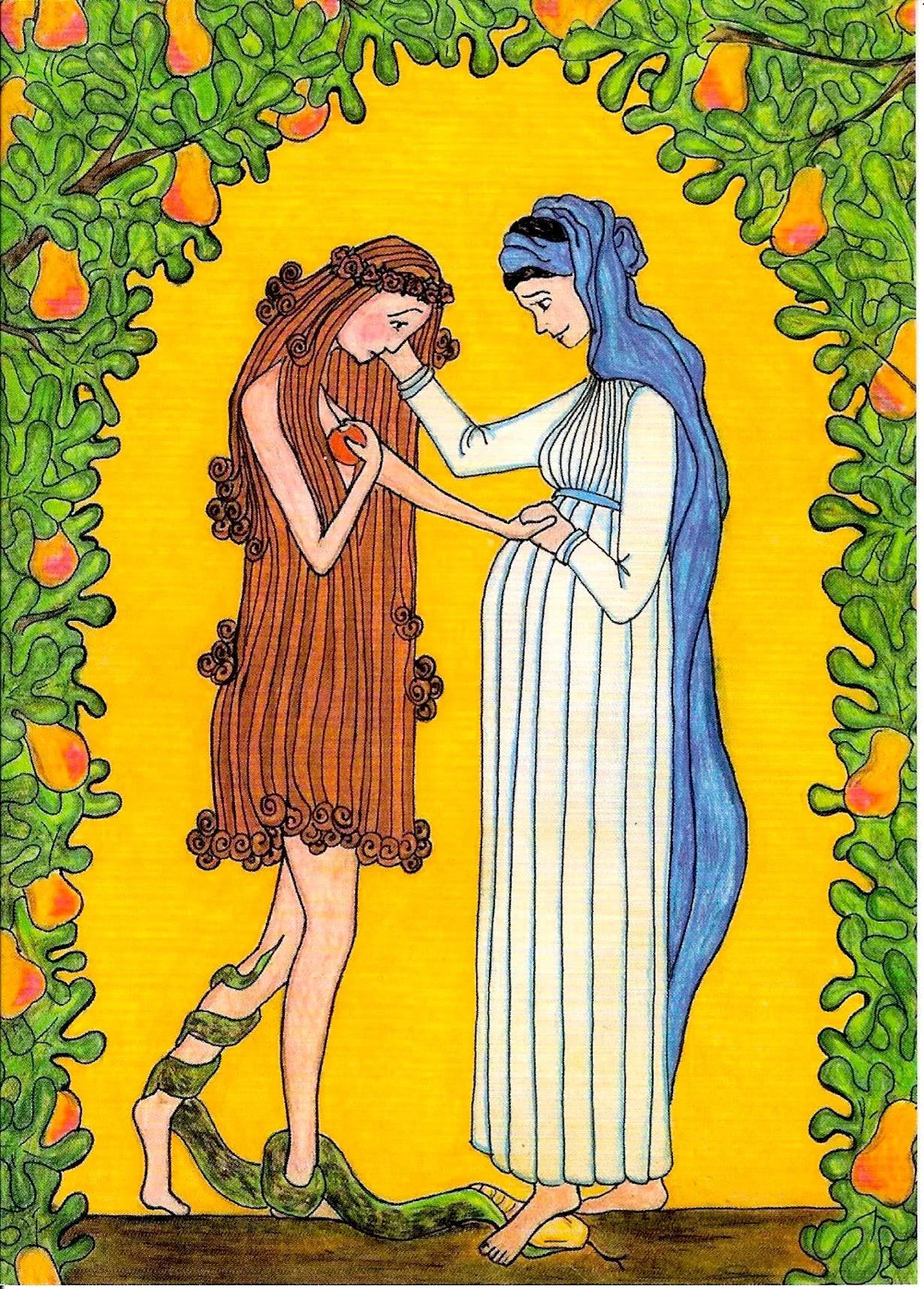
Where Eve (then Adam) failed, Jesus succeeded.
Glory to God. Glory to Jesus. This is amazing news.
Unfortunately, however, it is all too easy for our lives to remain unchanged by this amazing news. “For many live as enemies of the cross of Christ,” Paul writes in Philippians 3.
19Their end is destruction, their god is the belly, and their glory is in their shame; their minds are set on earthly things.
I hate how much I relate to this. I guess that is why I am thankful for a season like Lent—a season dedicated to following Jesus into that 40-day wilderness which He concluded by showing Satan who’s boss. I can do that too, in His strength.
“Draw near to God, and he will draw near to you,” writes St. James in the fourth chapter of the epistle which bears his name.
9Lament and mourn and weep. Let your laughter be turned into mourning and your joy into dejection.
I love how Ashley Tumlin Wallace frames this “mourning.”

In her recent essay on the spiritual practice of fasting, she explains how fasting ushers us into a mode of “grieving [or mourning] over the state of our hearts and the state of the world.” As Jesus promised in the Sermon on the Mount, those who mourn in this way “will be comforted” (Matthew 5:4). And as His half-brother James encourages us (also in James 4):
10Humble yourselves before the Lord, and he will exalt you.
It really makes you wonder: What does it look like to be exalted by God? I am not sure, but I will bet you that it probably has a lot to do with being His friend. I can think of no greater honour than that. Perhaps this is why it comes at such a cost. Consider 1 John 2.
15Do not love the world or the things in the world. The love of the Father is not in those who love the world, 16for all that is in the world—the desire of the flesh, the desire of the eyes, the pride in riches—comes not from the Father but from the world. 17And the world and its desire are passing away, but those who do the will of God abide forever.
We are called to reject the forbidden fruit with all the ways that it manifests itself in today’s world. Why? Because “friendship with the world is enmity with God” (James 4:4).
In other words, it takes a rejection of the trees which tempt us in order to fully enter into the abundant forest that is God’s Kingdom.
May this Lent carry us each through the wilderness and back into that garden.
P.S. Enjoy this word from the man who taught me most of what I know about fasting:
