


Harrison Burnette, one of my Substack frens ever since I came after him in a passionate rant last December, published a comprehensive essay roughly two months later in which he proposed “four rules for engaging in charitable discourse.” It is the second of those rules — “Always represent the other person’s view fairly” — which I wish to revisit in light of recent happenings in North America’s Anglican Church.
It is no secret that North American Anglicans have been deeply divided for many decades now. In the United States, The Episcopal Church (TEC for short) has existed for almost 250 years and was the only major expression of Anglicanism in the country until the Anglican Church in North America (ACNA) was founded 17 years ago. It is important to note that the ACNA was only ever founded due to TEC’s longstanding commitment to holding the most unrecognizably Christian of liberal stances on various social issues. TEC has maintained a pro-choice position on the question of abortion since 1967, for example, and famously consecrated — if one may use that word here — an actively homosexual man to the office of bishop in 2003. The ACNA was originally established as a bulwark against the moral rot indicated by these decisions.
In October 2025, it would ultimately join the majority of global Anglicans in breaking communion with the Church of England and with all others, TEC included, who have “abandoned the inerrant word of God as the final authority.” This is why South Carolina’s ACNA bishop drew headlines last month when he combined with the state’s TEC bishop to dedicate a new chapel at a local school.
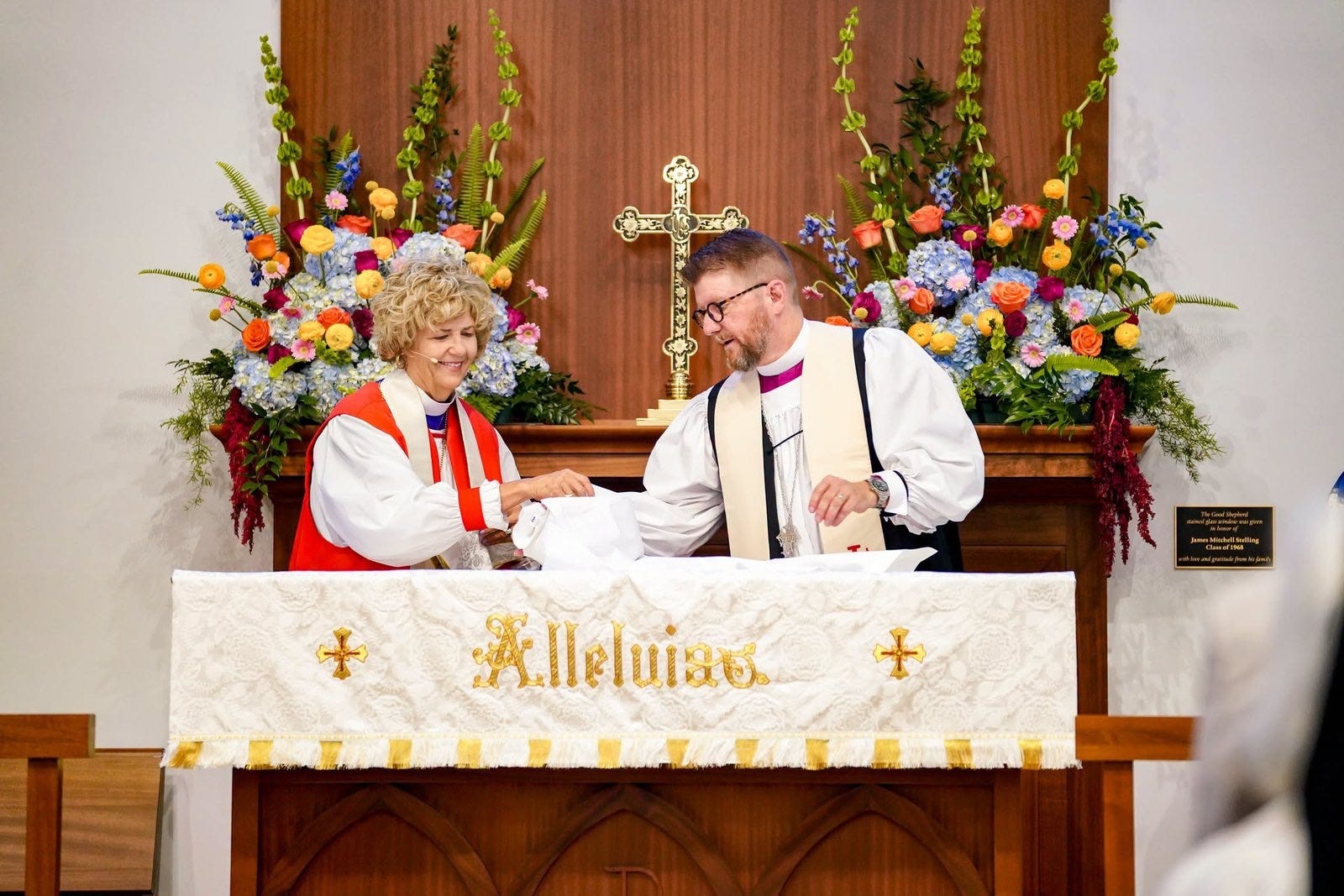
As a member of the ACNA myself, I will refrain from weighing in on the Episcopalian reaction to the event—assuming that there has been much of one at all. I wouldn’t know. What I can comment on, however, is the intra-ACNA discourse surrounding what I will refer to from here on out as Porter-Gate.
On the one hand, there has been a choir of voices raising principled concerns over the symbolism of Bishop Edgar’s actions on August 18th. Drawing on St. Paul’s statement in 1 Corinthians 10:17 that “we who are many are one body, for we all partake of the one bread,” the Rev. Canon Jeff Weber, for one, takes particular issue with the fact that the two bishops in question served the Lord’s Supper together at the service which followed the dedication of St. Timothy’s Chapel. Self-described curmudgeon Mark Marshall inquires along similar lines: “Why continue ACNA if our bishops can recognize and commune with TEC bishops as they please?”
The reliably sassy yet refreshingly earnest Anne Kennedy, meanwhile, “wouldn’t want even to pass out a bowl of soup with a person who said she is a Christian but did not believe” the authentic Gospel. She clarifies, though, that she would happily “eat soup with any kind of person—pagan, Zoroastrian, Witch-Tokker—who was mainly interested in the soup and had no clear thoughts about ‘the Gospel.’” She insists that she is not being “pedantic.” Rather, she simply believes that the Gospel is a “matter of eternal life and eternal death.”
There is, of course, another side to the Porter-Gate fallout within the ACNA. It is represented by a cohort of clergy who unequivocally stand behind Bishop Edgar and his performance at the traditionally Episcopalian Porter-Gaud School. One of them, the Rev. Zach Barton, makes a distinctly mission-focused defense of the bishop:
I think we need to be thoughtful and careful about these kinds of intersections but not so careful that we remove ourselves from ministry to people. ACNA needs to continue to be heavily involved in P-G because God has been blessing the ACNA chaplains' work there. We have to be able to exist in the same spaces. We can't just pull back from the world because of "doctrinal purity." We know what our doctrine is and we know where our mission field is.
This is not to mention that, as the Rev. Taylor Daniel helpfully points out, one of America’s foremost Anglican seminaries — Wisconsin’s Nashotah House — has been known to regularly have “TEC bishops come and give communion to ACNAers.” Father Daniel adds:
We’re either into this total separation or we’re not.
Let’s get some clearer guidance, College of Bishops!
Bishop Edgar himself, in a letter delivered to the clergy in his diocese a week after Porter-Gate, humbly called for the College of Bishops to “spend a season of prayer and reflection on these issues and provide guidance for how we interact with the Episcopal Church in these unique settings.” “As a bishop in the church,” he continued, “I will follow the College’s conclusion.”
The Rt. Rev. Julian Dobbs, acting in his capacity as Dean of the ACNA, responded swiftly. “The Anglican Church in North America is not in communion with The Episcopal Church,” he wrote, “and those who hold ecclesiastical authority in our Province bear a solemn responsibility to uphold this position.” Dean Dobbs promised to “lay the seriousness of this situation before the bishops” at their scheduled meeting in Plano, Texas later this month. He will “ask them to consider… what faithfulness to our Lord and the faith we have received requires of those who have been entrusted with ecclesiastical authority.”
Bishop Edgar has since been charged with “just cause for scandal or offense in violation of the disciplinary canons of the ACNA.” He has accepted the charge and will be “disciplined by the College of Bishops when it gathers later this month.” I agree with the Rev. Steven Wedgeworth’s take on this news:
I can only imagine how hard it is being the focus of a public controversy, while also being a bishop who represents an entire diocese, and its varying commitments, dispositions, and goals. Acknowledging your mistake, repenting of your sin, and accepting the judgment of your brothers is the right thing to do. This was good for [Bishop Edgar], and it is certainly good for the church.
I also agree with Father Wedgeworth’s critique of the wider discourse surrounding Porter-Gate:
Sometimes the jerks are the jerks. But sometimes people misidentify the jerks and end up becoming jerks themselves. I’ve seen plenty of name-calling and poor form all around.
Between out-of-context appeals to the Sermon on the Mount and strange calls to “touch grass,” there has been no shortage of unfair and dismissive argumentation from the very people who have made a habit of advocating for charitable speech online. My personal favourite example comes courtesy of my aforementioned stack-fren:
I am simply concerned that arguing like a mean girl is unlikely to lead us anywhere good.

Speaking of girls…
Anyone who knows anything about the ACNA knows that the singular most contentious issue in our province is the question of women’s ordination—commonly referred to as WO. Allow me to take this opportunity to hearken back to the Rev. David Roseberry’s exhortation last July to apply Burnette’s second rule for engaging in charitable discourse — Always represent the other person’s view fairly — to our intra-provincial discussions surrounding WO. In Father Roseberry’s words:
Too often we caricature one another. Complementarians are accused of diminishing women. Egalitarians are accused of surrendering to modern culture. While those accusations may occasionally fit particular individuals, they do not fairly describe the convictions of many faithful Anglicans on either side.
He is correct in acknowledging that some complementarians do indeed oppose WO — whether they realize it or not — out of a deep-seated misogyny. By the same token, many support WO because their worldview is indistinguishable from the woke Left’s. That said, assuming positive intent and “steelmanning” rather than “strawmanning” our opponents’ positions is the only way to ensure that our dialogue will prove itself both productive and God-honouring.
i will say, as somebody who has 1) personally benefited from Bp. Edgar’s life, ministry, and christian witness (church of the apostles columbia is where i became anglican), and 2) is generally pretty sympathetic to TEC and the amount of wonderful and good things there, it has been hard to feel anything but eye-rolls over this. especially when the situation is compared with the ACNA’s reaction to much more severe causes for “scandal,” regarding the safe-guarding of children and the vulnerable in sexual misconduct cases as well as conduct unbecoming clergy online and in-person. i say the whole thing is absurd because the reaction and response to the service was so severe compared to much greater issues plaguing the church. but you’re right as always in challenging me to live up to my own standards better
Some members of both sides would actually benefit from a crash course in the opposition’s position. I’ve spoken to many on the anti-WO side who are sick of being reduced to misogynists (while acknowledging that some on their side are), but in my own experience, I’m far more used to see the pro-WO side caricatured as just progressivism, women’s empowerment for its own sake, or any such thing. Almost none of the loudest voices (online, that is) against WO in the ACNA even acknowledge that a scriptural argument exists in its favor.
I agree the mean girl approach doesn’t get us much (except copious amount of followers online, in some cases), but I also understand why people can get frustrated over being so constantly misrepresented.