


FRIDAY MORNING. 7am.
I’ve just dropped off my friend at the ferry terminal but my workday will not be starting for another ninety minutes.
The strange heaviness of heart I awoke with at the crack of dawn has not faded so I begin doomscrolling to lighten the mood. I am also an intellectual though, so — naturally — it is my Substack feed which I am mainly perusing. An article entitled “I’m Learning How to Pray” catches my eye.
Its author, a blogger named Makinsay, confesses that she does “not often sit in silence and solitude for any meaningful length of time.” She is aware that she is missing out, which is why she has resolved to “set aside specific time for prayer”—time “to submit anxieties, to confess idolatries, to sort through [her] affections and desires.”
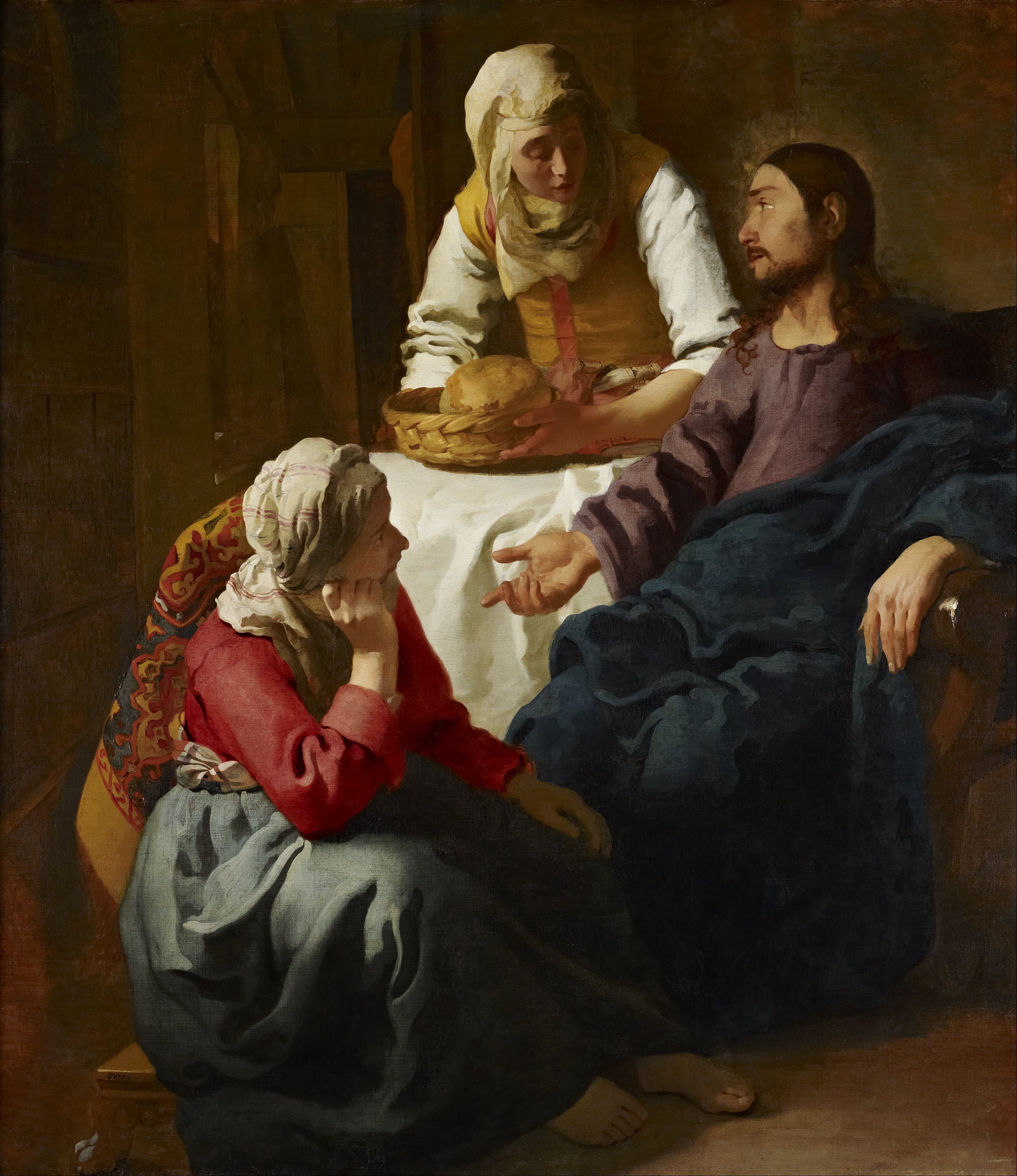
She is inspired by Jesus’s interaction with Mary and Martha in the tenth chapter of Luke’s Gospel:
38Now as they went on their way, he entered a certain village where a woman named Martha welcomed him. 39She had a sister named Mary, who sat at Jesus’s feet and listened to what he was saying. 40But Martha was distracted by her many tasks, so she came to him and asked, “Lord, do you not care that my sister has left me to do all the work by myself? Tell her, then, to help me.” 41But the Lord answered her, “Martha, Martha, you are worried and distracted by many things, 42but few things are needed—indeed only one. Mary has chosen the better part, which will not be taken away from her.”
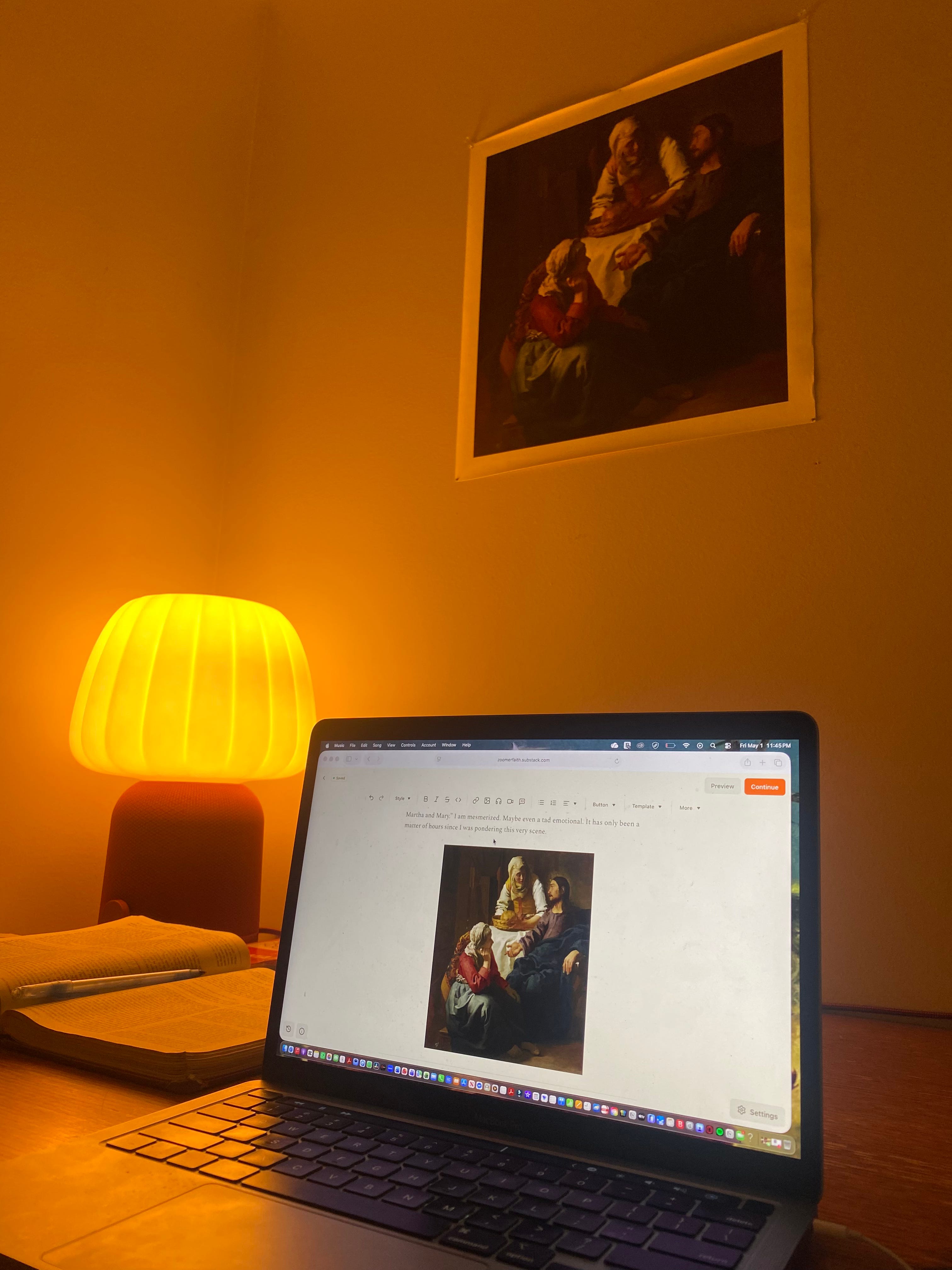
Makinsay’s article features Johannes Vermeer’s 1654 painting, “Christ in the House of Martha and Mary.” I am mesmerized. Maybe even a tad emotional. It has only been a matter of hours since I was pondering this very scene.
THURSDAY NIGHT. 11pm.
My roommate Kyler is singing to Jesus and playing his guitar in our living room. I, meanwhile, am pacing in my room, “worried and distracted by many things.” They are all good things—at least I think so. But they feel so urgent. The truth is, they feel considerably more urgent than sitting at the feet of Jesus does right now.
Not only are my self-imposed Substack deadlines calling my name, but I am set to spend much of my weekend volunteering—first at an Apologetics Canada conference and then at my own local church the next day. Surely, there will be plenty of time for abiding after the work is finished, I tell myself. Jesus is not going anywhere anytime soon, is He? Something tells me Martha of Bethany would have been all too familiar with my line of reasoning.
The seventeenth century French philosopher Blaise Pascal, in his legendary Pensées, famously argued that “all of humanity’s problems stem from man’s inability to sit quietly in a room alone.” Centuries earlier, in his equally influential Confessions, St. Augustine had written thusly about humankind: “Our hearts are restless until they rest in [God].”
One can easily argue, on the basis of these two strikingly similar ideas, that man’s inability to sit quietly in a room long enough to rest in his Creator constitutes his deepest heart issue. Maybe that is why I have chosen to go to sleep without praying tonight—because my heart is sick (with sin), and not because I must drive Kholine to her boat first thing in the morning.
THE LATE ANGLICAN CLERGYMAN and apologist, Fr. Thomas Mckenzie, wrote in his 2014 The Anglican Way of the historical Anglican church’s “strong tradition of contemplative activism.” Among the “fruits of contemplation” he lists in the book are “knowing God’s grace, resting in his presence [and] being detached from the world.” These fruits, Mckenzie argues, “can fuel our service to others.”
In other words, Christian contemplation leads to Christian activism. Being with God leads to doing for God—or, better yet, to doing from God. In his chapter on Christian activism, McKenzie writes that the New Testament writer James is the “unofficial ‘patron saint’ of the Christian activist.” He then goes on to quote directly from the second chapter of James’s epistle:
14What good is it, my brothers and sisters, if someone claims to have faith but does not have works? Surely that faith cannot save, can it? 15If a brother or sister is naked and lacks daily food 16and one of you says to them, “Go in peace; keep warm and eat your fill,” and yet you do not supply their bodily needs, what is the good of that? 17So faith by itself, if it has no works, is dead.
“So contemplation by itself, if it has no activism, is dead.” (Sacha Mugisha Version)
Our being with God is indeed ineffectual if it does not propel us further into practical love for our fellow man. Fair enough.
What happens, though, when it is our activism which is left “by itself,” having no contemplation? I believe Jesus addresses this question towards the end of His Sermon on the Mount. As per Matthew 7:
21“Not everyone who says to me, ‘Lord, Lord,’ will enter the kingdom of heaven, but only the one who does the will of my Father in heaven. 22On that day many will say to me, ‘Lord, Lord, did we not prophesy in your name, and cast out demons in your name, and do many mighty works in your name?’ 23Then I will declare to them, ‘I never knew you; go away from me, you who behave lawlessly.’
I hear echoes of 1 John 3:
6No one who abides in him sins; no one who sins has either seen him or known him.
Jesus’s real followers know and are known by Him. Their inner lives are transformed through contemplation, and their outer lives reflect that. Jesus’s fake followers, on the other hand, have no time for abiding in, beholding or contemplating His beauty. They may possess impressive ministry resumes, but their relationships with God are barely existent; their inner lives utterly untransformed.
Herein lies a sobering warning to me and all my fellow Martha types. The ultimate price of allowing service and activism to distract entirely from abiding in Christ is high. Contemplation must come first—in the same way that faith begets righteousness, and not the other way around (Romans 4:3). This is why Jesus told Martha that her sister had “chosen the better part” in the Luke 10 story. Mary got it. I want to be like her.
Vermeer’s painting is now nailed to my wall and I hope that it will inspire me such that — when I am not anointing Jesus’s feet (as Mary would go on to do with costly perfume in John 12) — I will be sitting at His feet, hanging on every word that comes out of His mouth.
Lord, have mercy.
This is so true!! Reminds me of this quote: "The secret to the Christian life is not in doing, but in being." - John G. Lake
This was very encouraging to read. Im in a tough season, but knowing Jesus wants us to abide in him helps me to draw near to him. In doing so my problems shrivel up and his love can enter in. I chose the better thing starting today!
Keep the blogs coming brotha.